
Be aware: semi-annual regulatory agenda is 1,700-pages online, 483 pages in print
Where are those rules? Be careful where you search to be sure you have found the correct and complete source. While there are some kinds of information (e.g., phone books) that are just easier to use online than in print (and the semi-annual regulatory agenda may be one of them), just putting them online may create new access problems (for those who don't have online access) and preservation problems (will these be saved and unaltered and by whom at what cost?). They may also present new problems of discovery when it is not easy to determine which of many versions is the complete one or the current one or which search produces the correct result.
And don't forget that one of the main motivations behind this switch is that the government wants to save money -- not expend more on preservation. GovExec.com says the shift to online publication of the Unified Agenda will "save" the government $800,000 (Agencies put regulatory plans online by Elizabeth Newell, December 11, 2007).
- 1,700 Pages of Rules, Fewer Dead Trees. By Cindy Skrzycki, Washington Post (December 18, 2007).
Until now, the Federal Register, the government's daily accounting of rules, printed the entire agenda in several bound volumes. It has been available online since 1995. Its search system, connected to the U.S. Government Printing Office, was challenging for some users....
The migration to http://www.reginfo.gov saves money and makes rulemaking more available to the public, administration officials said....
The agenda is available on two other government sites. The Federal Register is still required to print two categories of rules, offering the partial agenda and plan in print and at http://www.gpoaccess.gov/ua/index.html.
The other site is http://www.regulations.gov, the electronic docket for commenting on rules.
OMBWatch notes that "Since the Unified Agenda has gone paperless, you will also be unable to find entries in the PDF version of the Federal Register on the Government Printing Office website" (Agencies' Regulatory Plans Available Online, December 12, 2007)
Continue reading
Vice President vs. National Archives
Challenging Cheney. Newsweek Web Exclusive (Updated: 12:57 PM ET Dec 24, 2007) By Michael Isikoff.
J. William Leonard learned the hard way the perils of questioning Vice President Dick Cheney. The veteran National Archives official challenged claims by the Office of Vice President (OVP) to be exempt from federal rules governing classified information. His efforts touched off a firestorm--and a counter-strike by Cheney's chief of staff, David Addington, who tried to wipe out Leonard's job....
Now, Leonard is quitting as director of the Archives' Information Security Oversight Office (ISOO)--the unit that monitors the handling of government secrets. He tells NEWSWEEK that his fight with Cheney's office was a "contributing" factor in his decision to retire after 34 years of government service.
..."The global struggle that we're engaged in today is more than anything else is an ideological struggle. And in my mind....that calls for greater transparency, not less transparency."
Continue reading
Public Access Mandate Made Law
Public Access Mandate Made Law, The Alliance for Taxpayer Access. December 26, 2007.
President Bush has signed into law the Consolidated Appropriations Act of 2007 (H.R. 2764), which includes a provision directing the National Institutes of Health (NIH) to provide the public with open online access to findings from its funded research. This is the first time the U.S. government has mandated public access to research funded by a major agency.Continue reading
Reopening EPA Libraries in Budget
CONGRESS DIRECTS EPA TO RE-OPEN ITS LIBRARIES. Public Employees for Environmental Responsibility (PEER). December 21, 2007
Buried within the omnibus appropriations bill Congress sent this week to President Bush is a Christmas present for the beleaguered library network of the U.S. Environmental Protection Agency. Congress ordered EPA to restore library services across the country and earmarked $3 million for that purpose...
The rationale for the library closures was never clearly spelled out by the agency, which maintained that it wanted to digitize all of its holdings. Its original claim of cost savings did not bear up under scrutiny and clashed with the enormous expense of digitizing hundreds of thousands of documents. In addition, the agency did not anticipated copyright restrictions, which barred many of its holdings from being digitized.
See more coverage of EPA libraries here.
Continue reading
New FRUS volume shows that Hoover Planned Mass Jailing in 1950
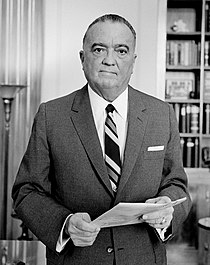 According to today's NY TImes, J. Edgar Hoover, the head of the Federal Bureau of Investigation (FBI) from 1924 - 1972, sent a plan on July 7, 1950 to President Truman to suspend habeas corpus and imprison some 12,000 Americans he suspected of disloyalty, saying that mass arrests were necessary to “protect the country against treason, espionage and sabotage.”
Hoover’s plan was declassified Friday as part of a collection of cold-war documents concerning intelligence issues from 1950 to 1955. The collection makes up a new volume of “The Foreign Relations of the United States,” a series that by law has been published continuously by the State Department since the Civil War.
Continue reading