
State Agency Databases Activity Report 11/20/2011
It has been two weeks since our last report, mostly because I've been wrapped up in National Novel Writing Month (NANOwrimo). Our volunteers remain active and productive at the State Agency Databases Across the Fifty States project. SUBJECT PAGE ACTIVITY Health Practitioner Databases (Lynn McClelland) With the addition of OK, OR, TX, WV and WY. Lynn now has 38 states plus the District of Columbia represented on this page. I was particularly surprised by the number of practioner databases were available for West Virginia. OTHER WIKI ACTIVITY See our last 14 days of activity at http://tinyurl.com/statedbs14d for a blow by blow description of changes to the wiki. Here are a few highlights: DATABASES ADDED INDIANA ( Kimberly Brown-Harden) Closed Institutions and Student Records - This website contains a database of defunct, or closed schools in Indiana and were accredited by the Commission. Students can also request academic transcripts. MISSOURI (Annie Moots) Missouri State Highway Patrol Online Boat/Drowning Incident Reports - From the web site: "Information on this site is preliminary information relating to boat incidents and drownings investigated by the Missouri State Highway Patrol, Water Patrol Division. (Incidents investigated by agencies outside the Missouri State Highway Patrol, Water Patrol Division are not included.) They are posted here automatically and remain online for 29 days." These are not official reports. NEW MEXICO (Adrienne Walker) Find Your Legislator - Locate current members of the House of Representatives and the Senate by name, district or zip code. Former legislators can be searched by name. There are also documents available listing current leadership, addresses, phone numbers and seating charts for the New Mexico House of Representatives and the Senate. OTHER STATE NEWS Liz Paulus has done EXTENSIVE link checking and fixing to the Oregon page. ORPHAN NEWS Our last official orphan remains Rhode Island. Will you be the one to take the last "unadopted orphan?" If you're interested in adopting Rhode Island, check out our volunteer guide and then send me an e-mail if you'd like to adopt it. If you adopt Rhode Island, be prepared to put your name and contact information on the main project page AND your state page within two weeks of receiving your wiki login. See the Volunteer guide for more details. Continue reading
Open Government Groups Urge Senators to Restore Funding for Transparency Efforts
Thanks OMB Watch and the Sunlight Foundation! These two open government groups just sent a letter to the Senate about the E-Gov Fund in the second “minibus” appropriations bill. In the letter, the groups raise and echo concerns regarding the funding level for e-government in the Statement of Administration Policy concerning H.R. 2354. They state that funding levels are inadequate to support crucial transparency programs such as USAspending.gov and Data.gov and ask that the E-Gov Fund remain a separate budget line to preserve the reporting requirements of the E-Gov Act, which provide transparency about how this money is spent. Here's the text of the OMBWatch/Sunlight letter:
November 16, 2011 Re: FY 2012 Appropriations for the Electronic Government Fund Dear Senators: We are writing to urge you to protect funding for the Electronic Government Fund at the General Services Administration in H.R. 2354, the Energy and Water Development and Related Agencies Appropriations Act. As currently written, H.R. 2354 would not provide adequate funding for the E-Gov Fund’s important programs, which provide critical support for the construction of a more transparent and efficient government and serve as a building block for private-sector innovations that create high-tech jobs. The E-Gov Fund has a proven track record of successful transparency projects that have delivered efficiency improvements and increased government accountability. For instance, USAspending.gov and the IT Dashboard have helped root out government waste and inefficiency and recently led to the elimination of some $3 billion in failing technology projects. PaymentAccuracy.gov shines a light on improper federal payments, which total billions of dollars each year, and Challenge.gov provides a low-cost platform to help agencies bring the public in to identify more efficient solutions to problems facing the country. In addition, E-Gov Fund projects provide the framework for vibrant private-sector business and job creation. The thousands of government data sets now available through Data.gov are building blocks for innovative new IT products. For instance, the search engine Bing now integrates Medicare quality data into searches for hospitals. Brightscope, a start-up company, has raised $2 million in venture capital and created 30 jobs through their analysis of retirement plan data from the Department of Labor. Unfortunately, cuts to the E-Gov Fund in FY 2011 have already hurt successful projects. Needed upgrades to increase transparency and improve data quality have been delayed or abandoned, and two early-stage projects have been terminated. Additional cuts will further hamper efforts to make government more efficient and transparent. These cuts are penny-wise and pound-foolish. The E-Gov Fund supports powerful tools for reducing waste, fraud, and abuse and for creating private-sector jobs, and given appropriate funding, these projects result in benefits far in excess of their costs. To support continued transparency, efficiency, and job creation, we respectfully urge you to restore full funding for the E-Gov Fund. In particular, we ask you to support the president’s recommendation of $34 million to preserve these important programs. We also ask that the E-Gov Fund remain separate from the Federal Citizen Services Fund, as requested in the Statement of Administration Policy on H.R. 2354. Because the proposed Information and Engagement for Citizens account would not be subject to reporting requirements of the Electronic Government Act of 2002 and has not been authorized by Congress, combining the funds would decrease government transparency and accountability. We appreciate your time and attention to this issue. If you have any questions or would like to discuss this issue further, please contact Sam Rosen-Amy of OMB Watch at (202) 683-4806 or Daniel Schuman of the Sunlight Foundation at (202) 742-1520 x 273. Sincerely, OMB Watch Sunlight FoundationContinue reading
New Government Report Looks at Broadband Adoption in U.S. and Shows Digital Divide Persists
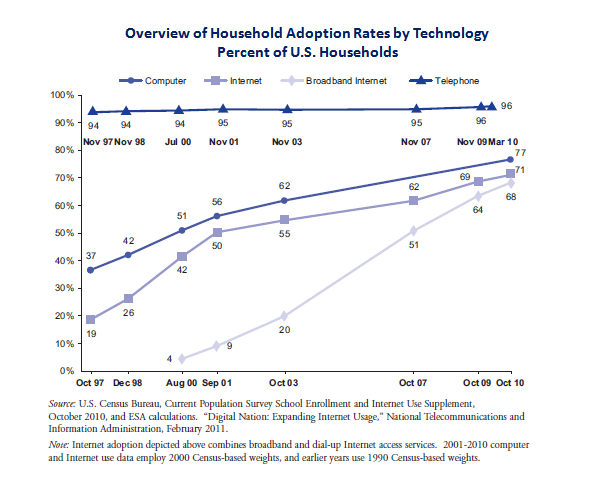
The Economics and Statistics Administration (ESA) and the National Telecommunications and Information Administration (NTIA) released a report today entitled Exploring the Digital Nation: Computer and Internet Use at Home (PDF). This report investigates broadband Internet use in the United States and finds that disparities continue to exist in broadband Internet adoption among demographic and geographic groups. The report also delves into the reasons why households have not adopted broadband Internet.Broadband internet adoption has increased substantially in only a few years, rising to 68% of households in 2010 from only 51% of households three years earlier and from 64% in 2009, the last time ESA and NTIA looked at these issues.
While this points to progress, a digital divide still exists between different racial and ethnic groups and between urban and rural areas in the United States. Broadband adoption rates varied substantially between different racial and ethnic groups, with 81% of Asian and 72% of White households having broadband Internet access, compared to only 55% and 57% of Black and Hispanic households. The urban-rural divide is also wide, with 70% of urban households having broadband Internet access compared to only 57% of rural households. Socio-economic differences, such as income and education, explain much – but not all – of this divide.
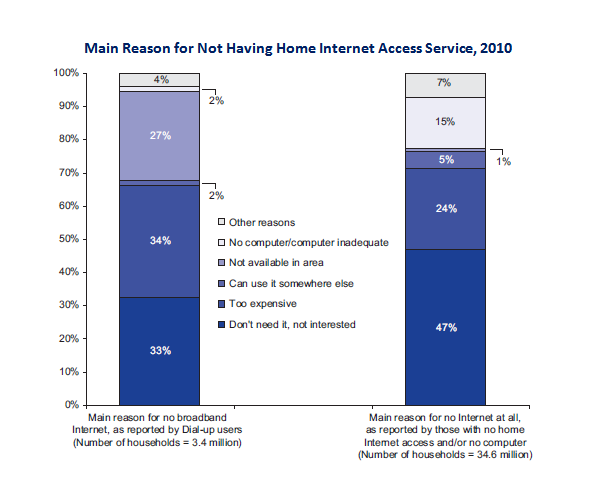
Here is what we know: Households that do not subscribe to any Internet service—dial-up or broadband —cited as the main reasons a lack of need or interest (47%); lack of affordability (24%); and an inadequate computer (15%). However, 27% of dial-up users -- a rapidly declining group of users --- indicated that they did not have broadband internet access service in their area.
Access the Full Text Report (72 Pages; PDF)
Overall
- Sixty-eight percent of American households used broadband Internet in 2010, up from 64 percent in 2009. Only three percent of households relied on dial-up access to the Internet in 2010, down from five percent in 2009. Another nine percent of households had people who accessed the Internet only outside of the home.
- All told, approximately 80 percent of American households had at least one Internet user, whether inside or outside the home and regardless of technology type used to access the Internet.
Differences in Household Broadband Adoption
- Cable modems and DSL were the leading broadband technologies for home Internet adoption, with 32 percent and 23 percent of households, respectively, using these services.
- Households with lower incomes and less education, as well as Blacks, Hispanics, people with disabilities, and rural residents, were less likely to have Internet service at home.
- Eighty-one percent of Asian households and 72 percent of White households had broadband at home, compared to 57 percent of Hispanic households and 55 percent of Black households.
- Seventy percent of urban households had broadband at home, compared to 57 percent of rural households.
- Households with school-age children were more likely to have broadband at home (78 percent) than the national rate. Older householders, particularly those ages 65 and older (45 percent), were less likely to have broadband at home.
- Less than half (43 percent) of households with annual incomes below $25,000 had broadband access at home, while 93 percent of households with incomes exceeding $100,000 had broadband.
Role of Socio-Economic Factors
- Average broadband adoption in 2010 varied by state from about half (52 percent) of all households to 80 percent.
- Socio-economic differences do not explain the entire broadband adoption gap. For example, after accounting for socio-economic and geographic factors, Black and Hispanic households still lag White households in broadband adoption by 11 percentage points, though the gap between Asian and White households disappears.
- After accounting for socio-economic and demographic factors, rural households still lag urban households in broadband adoption by five percentage points.
- In contrast, differences in socio-economic characteristics do explain a substantial portion but not all of the broadband adoption lag among people with disabilities.
Reasons for Not Subscribing to Broadband at HomeAccess the Full Text Report (72 Pages; PDF) Continue reading
- The main reasons cited for not having Internet access at home were a lack of interest or need (47 percent), the expense (24 percent), and the lack of an adequate computer (15 percent).
Long-term Trends in Internet and Computer Use
- Not surprisingly, individuals without broadband service at home relied on locations such as public libraries (20 percent) or other people’s houses (12 percent) to go online.
- Between 2001 and 2010, broadband Internet use at home, regardless of technology type, rose from 9 percent to 68 percent of households.
- Between 1997 and 2010, Internet use among households, regardless of technology type, rose from 19 percent to 71 percent.
- More than three quarters (77 percent) of American households had a computer at home in 2010, up from 62 percent in 2003.
New From NARA: National Archives Publishes National Registry of Controlled Unclassified Information
Reposted with Permission from INFOdocket.com From NARA:
On November 4, 2010, President Obama signed Executive Order 13556, "Controlled Unclassified Information (CUI)," and designated the National Archives and Records Administration as the Executive Agent "to implement this order and oversee agency actions to ensure compliance with this order." On November 4, 2011, as required by this Executive Order, the National Archives Controlled Unclassified Information Office established a publically available registry reflecting the initial categories and subcategories of unclassified information that require dissemination or safeguarding controls consistent with and pursuant to law, regulation, and Government-wide policy. This registry is online. [Clip] The CUI program will be implemented in phases based on compliance plans and target dates to be submitted by executive agencies and departments. When fully implemented, the CUI program will require executive departments and agencies to exclusively use these categories for controlling and marking such unclassified information. The National Archives will consult with the agencies and the Office of Management and Budget and then set implementation deadlines for CUI, to include for applying standardized CUI markings. Currently, there are more than 100 different policies for such information across the Executive branch. This plethora of policies has created inefficiency and confusion, leading to a patchwork system that fails to adequately safeguard information requiring protection, and unnecessarily restricts information sharing by creating needless impediments.Learn More ||| Access the Registry Read the Complete Announcement Continue reading
New Geospatial Platform Website
"The federal government and its geospatial partners today unveiled www.geoplatform.gov, a prototype Geospatial Platform website providing an initial view of the future of user-friendly, integrated, federal data collections on common geographic maps." (Federal Geographic Data Committee Launches New Geospatial Website, press release, U.S. Department of the Interior (11/09/2011). "This prototype version of the Geospatial Platform combines map-based data and tools with the latest internet technologies to deliver geospatial information in a simple, understandable package. Users—including the public, federal agencies and their partners—can easily find federally-maintained geospatial data, services and applications, as well as access data from our partners across State, Tribal, Regional and local governments."
- Geospatial Platform Explore, Collaborate, Build
- Interior Launches New Crowdsourcing Map Portal, By Joseph Marks, TechInsider (11/10/11).