
Secret Laws: FISA: The Movie!
Rushed Debate on Federal Spying Powers, CATO Institute, six minute video posted as "FISA: The Movie!" on the Association of Research Libraries "Policy Notes" site. A nice summary of the Foreign Intelligence Surveillance Act (FISA) domestic spying "debate" and re-authorization over the holidays. Continue reading
A handy breakdown of what’s in the “fiscal-cliff” bill
The Good, the Bad, and the Ugly in the Fiscal Cliff Package, "Savings and Costs in the Fiscal Cliff Package" [table] The Committee for a Responsible Federal Budget (January 1, 2013). This is based in part on the document:
- Estimated Revenue Effects Of The Revenue Provisions Contained In An Amendment In The Nature Of A Substitute To H.R.8, The "American Taxpayer Relief Act Of 2012," As Passed By The Senate On January 1, 2013 Fiscal Years 2013 - 2022, JCX-1-13 Joint Committee On Taxation (January 1, 2013).
Update: The Fiscal Cliff Process was an Atrocious, Secretive Mess
John Wonderlich does a good job of summing up how openness was a casualty of the so-called fiscal cliff drama.
- The Fiscal Cliff Process was an Atrocious, Secretive Mess, by John Wonderlich, Sunlight Foundation (Jan. 2, 2013). As we expected, the culmination of the "fiscal cliff" negotiations was a rush to the finish line, in which policies decided by a few men in a room were passed through the Congress without amendment.
- 6 Things You Won't Believe That Are In The Fiscal Cliff Bill That The Senate Passed At 2 AM While Most Americans Were Drunk, by Joe Weisenthal, Business Insider (Jan. 1, 2013). ...why is the bill 157-pages long? There's a provision extending a tax policy related to Puerto Rican rum... a tax credit for 2- and 3-wheel electric vehicles... An extension of some special rules for the film and television business... A gift to the car-racing world... Help to asparagus farmers...
Happy New Year 2013! What Could Have Entered the Public Domain on January 1, 2013?
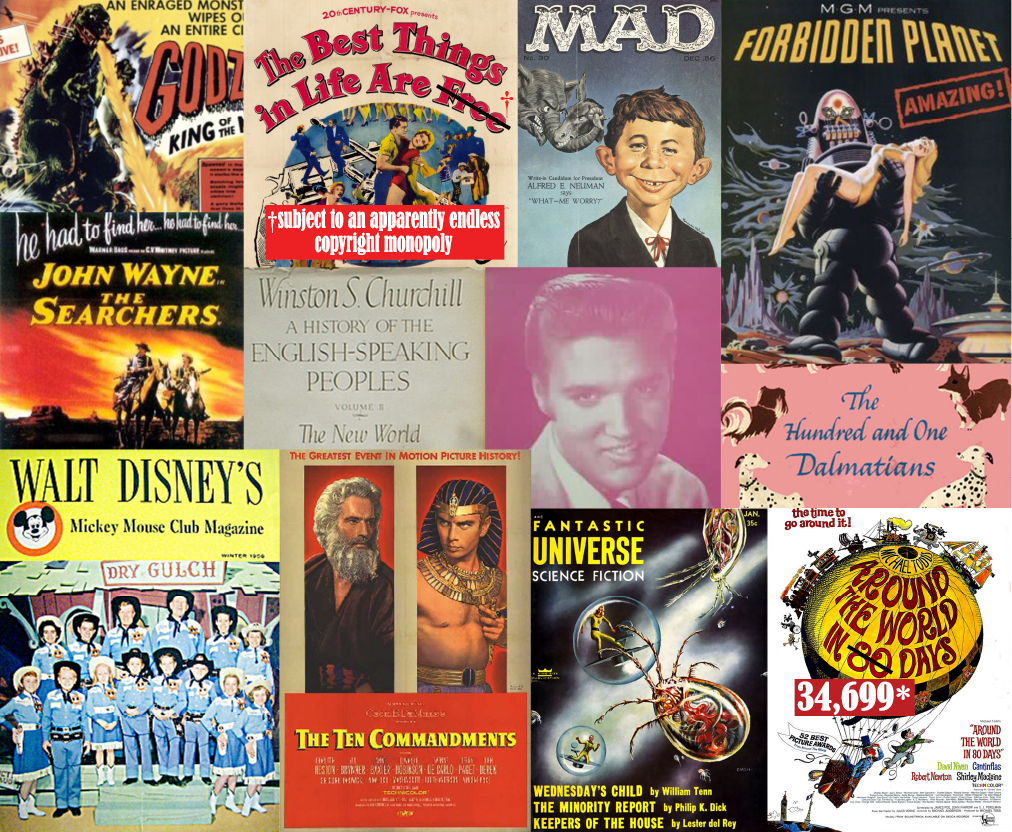 Happy 2013 FGI readers! As we begin the new year, it's always good to be reminded every year by Jennifer Jenkins and James Boyle and rest of the fine folks at the Duke Center for the Study of the Public Domain about the number of books, film and music that could have entered the public domain this year were it not for the 1976 Copyright Act. It's a fascinating and depressing read, especially the scientific material that may never become truly free and open knowledge -- not to mention the Scifi ("Minority Report" and Around The World in 80 Days -- the movie -- should have been "Around The World in 34,699 Days"), music, films, and literature.
Current US law extends copyright for 70 years after the date of the author’s death, and corporate “works-for-hire” are copyrighted for 95 years after publication. But prior to the 1976 Copyright Act (which became effective in 1978), the maximum copyright term was 56 years – an initial term of 28 years, renewable for another 28 years. Under those laws, works published in 1956 would enter the public domain on January 1, 2013, where they would be “free as the air to common use.” Under current copyright law, we’ll have to wait until 2052. And no published works will enter our public domain until 2019. What books would be entering the public domain if we had the pre-1978 copyright laws? You might recognize some of the titles below. * Winston Churchill, A History of the English-Speaking Peoples, Volume I and Volume II * Philip K. Dick, Minority Report * Ian Fleming, Diamonds are Forever * Fred Gibson, Old Yeller * Billie Holiday, Lady Sings the Blues * Alan Lerner, My Fair Lady * Eugene O’Neill, Long Day’s Journey into Night * John Osborne, Look Back in Anger * Dodie Smith, 101 Dalmatians Here are a few of the movies that we won’t see in the public domain for another 39 years. * Around the World in 80 Days * The Best Things in Life are Free * Forbidden Planet * Godzilla, King of the Monsters! * It Conquered the World * The King and I * The Man Who Knew Too Much (1956 remake by Alfred Hitchcock of his 1934 British film) * Moby Dick * The Searchers (1956 film version with John Wayne from Alan Le May’s 1954 novel) * The Ten Commandments (1956 version by Cecil B. DeMille, who also directed a similar film in 1923)[HT BoingBoing!] Continue reading
Census to offer internet response option for ACS
Census Bureau to Offer American Community Survey Internet Response, press release (MONDAY, DEC. 17, 2012)
The American Community Survey, the most detailed portrait of America's towns and neighborhoods, is now more convenient for most participants with the added availability of responding online. That will make it the 61st U.S. Census Bureau survey with Internet response... Households selected to participate in the American Community Survey will receive a letter in the mail with instructions about how to log in to the secure website and complete the survey online... If households selected to participate in the survey do not use the online response option, the Census Bureau will send them a paper questionnaire, or contact them by phone or in person to obtain answers.See also:
- Developing an Internet Response Mode for the American Community Survey, by Mary C. Davis, Jennifer Guarino Tancreto, and Mary Frances Zelenak, Decennial Statistical Studies Division U.S. Census Bureau, FedCASIC (March 23, 2011).
- Design of the American Community Survey Internet?Instrument: Final Report, by Jennifer Guarino Tancreto, Mary Davis, Mary Frances Zelenak. American Community Survey Research and Evaluation Program (April 18, 2012)