
Home » Posts tagged 'public domain' (Page 3)
Tag Archives: public domain
RIP Aaron Swartz, Friend of libraries and open information activist
 Shinjoung and I were stunned when we heard the news early yesterday morning that our friend -- and supreme friend of libraries and the Internet! -- Aaron Swartz left this world late friday evening. Aaron was deeply committed to and passionate about internet freedom and making information and knowledge as available as possible. To those ends, he worked on many projects large and small in his short but influential life. He was 26.
The *many* heartfelt remembrances from communities as diverse as journalism, law and open source tech -- witness Rick Perlstein, Lawrence Lessig, Glenn Greenwald, Karl Fogel -- attest to Aaron's supreme impact on the world at large (and that's no hyperbole!).
Before I had even heard of his tragic demise, a few colleagues and I were in the midst of writing letters of support for Aaron's nomination for this year's James Madison award from the American Library Association (ALA). This award, named in honor of President James Madison, was established by the ALA in 1986 to honor individuals or groups who have championed, protected and promoted public access to government information and the public’s “right to know” on the national level. I hope now that ALA will award Aaron posthumously!
We're helping Archive-it staff harvest a Web archive of Aaron's work, writings, images, videos, and remembrances. If you've got a URI that you'd like to be included in the archive, please paste it to this Google Doc.
Remembrances of Aaron, as well as donations in his memory, can be submitted at http://rememberaaronsw.com
The world will miss you Aaron. Be at peace my friend!
Shinjoung and I were stunned when we heard the news early yesterday morning that our friend -- and supreme friend of libraries and the Internet! -- Aaron Swartz left this world late friday evening. Aaron was deeply committed to and passionate about internet freedom and making information and knowledge as available as possible. To those ends, he worked on many projects large and small in his short but influential life. He was 26.
The *many* heartfelt remembrances from communities as diverse as journalism, law and open source tech -- witness Rick Perlstein, Lawrence Lessig, Glenn Greenwald, Karl Fogel -- attest to Aaron's supreme impact on the world at large (and that's no hyperbole!).
Before I had even heard of his tragic demise, a few colleagues and I were in the midst of writing letters of support for Aaron's nomination for this year's James Madison award from the American Library Association (ALA). This award, named in honor of President James Madison, was established by the ALA in 1986 to honor individuals or groups who have championed, protected and promoted public access to government information and the public’s “right to know” on the national level. I hope now that ALA will award Aaron posthumously!
We're helping Archive-it staff harvest a Web archive of Aaron's work, writings, images, videos, and remembrances. If you've got a URI that you'd like to be included in the archive, please paste it to this Google Doc.
Remembrances of Aaron, as well as donations in his memory, can be submitted at http://rememberaaronsw.com
The world will miss you Aaron. Be at peace my friend!
Happy New Year 2013! What Could Have Entered the Public Domain on January 1, 2013?
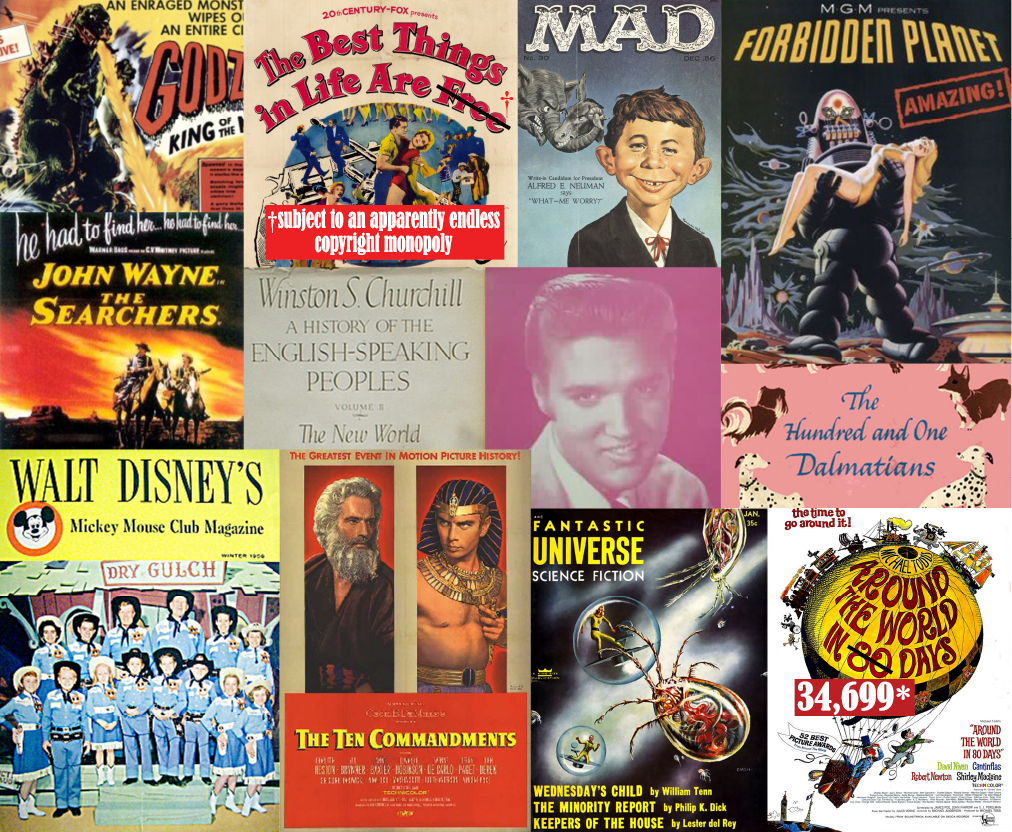 Happy 2013 FGI readers! As we begin the new year, it's always good to be reminded every year by Jennifer Jenkins and James Boyle and rest of the fine folks at the Duke Center for the Study of the Public Domain about the number of books, film and music that could have entered the public domain this year were it not for the 1976 Copyright Act. It's a fascinating and depressing read, especially the scientific material that may never become truly free and open knowledge -- not to mention the Scifi ("Minority Report" and Around The World in 80 Days -- the movie -- should have been "Around The World in 34,699 Days"), music, films, and literature.
Current US law extends copyright for 70 years after the date of the author’s death, and corporate “works-for-hire” are copyrighted for 95 years after publication. But prior to the 1976 Copyright Act (which became effective in 1978), the maximum copyright term was 56 years – an initial term of 28 years, renewable for another 28 years. Under those laws, works published in 1956 would enter the public domain on January 1, 2013, where they would be “free as the air to common use.” Under current copyright law, we’ll have to wait until 2052. And no published works will enter our public domain until 2019. What books would be entering the public domain if we had the pre-1978 copyright laws? You might recognize some of the titles below. * Winston Churchill, A History of the English-Speaking Peoples, Volume I and Volume II * Philip K. Dick, Minority Report * Ian Fleming, Diamonds are Forever * Fred Gibson, Old Yeller * Billie Holiday, Lady Sings the Blues * Alan Lerner, My Fair Lady * Eugene O’Neill, Long Day’s Journey into Night * John Osborne, Look Back in Anger * Dodie Smith, 101 Dalmatians Here are a few of the movies that we won’t see in the public domain for another 39 years. * Around the World in 80 Days * The Best Things in Life are Free * Forbidden Planet * Godzilla, King of the Monsters! * It Conquered the World * The King and I * The Man Who Knew Too Much (1956 remake by Alfred Hitchcock of his 1934 British film) * Moby Dick * The Searchers (1956 film version with John Wayne from Alan Le May’s 1954 novel) * The Ten Commandments (1956 version by Cecil B. DeMille, who also directed a similar film in 1923)[HT BoingBoing!] Continue reading
Happy Public Domain Day 2012 … except in the US
Happy Public Domain Day! Welcome to the Public Domain Louis Brandeis, James Joyce, Jelly Roll Morton, Virginia Woolf and others. John Mark Ockerbloom has a list of 5 things that we can do in the US to improve access to public domain works.
It’s New Year’s Day again, and in much of the world, this means another year’s worth of works enter the public domain. That’s a cause for celebration, as Europe and many other countries that have “life+70 years” copyright terms welcome works by James Joyce, Virginia Woolf, Jelly Roll Morton, and Elizabeth von Arnim into the public domain. The Communia Project’s Public Domain Day website focuses on works by these and many other authors that are entering (in many cases, re-entering) the public domain in “life+70 years” countries. Meanwhile, folks in Canada, New Zealand, and other countries that have held the line at the “life+50 years” terms of the Berne Convention can now freely enjoy the works of people like James Thurber, Ernest Hemingway, and H.D. There’s not so much excitement about Public Domain Day in the US, where no published works are scheduled to enter the public domain for another 7 years, due to a 20-year copyright extension enacted in 1998.[HT John Mark Ockerbloom via LISnews!] Continue reading
book scan wizard + internet archive = DIY public domain digital book repository
At the last couple of depository library council meetings, I've heard comments from documents librarians -- especially from librarians at smaller institutions -- that they'd love to participate in the digitization process of historic government documents, but for various reasons (lack of $$, staffing, time, technical infrastructure etc) could not undertake large scale digitization projects. Now there's a way for lots of libraries to chip in on the greater goal of increased access to historic government documents with very little $$ or infrastructure. We've mentioned before about BookLiberator and DIYbookscanner, two projects working on low cost hardware solutions for digitizing books using off the shelf digital cameras and free opensource software called Book Scan Wizard. But there were still 2 pieces missing to make the whole workflow run smoothly for libraries and government documents collections of all sizes. The third piece to the puzzle just became a reality with yesterday's announcement that Book Scan Wizard had teamed up with the Internet Archive to provide automatic uploads of scans to the Internet Archive (directions and more information here). Hardware: check. Software: check. Digital infrastructure: check.
With the new version of Book Scan Wizard, or even through just uploading directly to the Internet Archive, any PDF composed of images of book pages or organized zip file filled with images of book pages will be automatically processed. The Internet Archive’s servers will then automatically perform optical character recognition (OCR) on the book and make a pdf, epub, kindle (mobi), daisy, djvu, and text file copy of the entire book available for download by anyone, anywhere. You can see a sample book from this process to get a better idea. All this happens within a few hours of the book being uploaded and then anyone can download it. This is free OCR for anyone in the world.Now there's one last piece needed: Scan on demand. This idea has already been put into practice by the Internet Archive's Open Library and their partnership with the Boston Public Library. What we need is to open up the Catalog of Government Publications (CGP) -- which will soon include over 1 million records from GPO's historic shelflist spanning 1870s - 1992 -- similar to the way the BPL's scan on demand project (now retired it seems) allowed users to request a scan of a public domain book directly from the Open Library catalog. GPO could manage this scan on demand process -- or allow libraries to pick and choose documents from the CGP -- connect the bibliographic metadata from the historic shelflist, and upload to both the Internet Archive and FDsys. The circle is complete. Am I missing anything? Would love to hear readers' thoughts.
38 groups ask LoC for free public access to CRS reports
Congressional Research Service (CRS) Reports are incredibly rich sources for budget-related information, and analyses of domestic social policy, foreign Affairs, defense and trade, and science and industry. But for many years, CRS has not provided direct public access to its reports, requiring citizens to request them from their Members of Congress -- and libraries to purchase them from Penny Hill Press, LexisNexis and other private publishers. With CRS Director Daniel Mulhollan retiring in April, 2011, this was an opportune time for 38 open government groups -- including FGI! -- to send a letter to Librarian of Congress James Billington asking him to appoint a new CRS Director who will facilitate free public online access to CRS reports. Here's the letter (PDF also available from OpenTheGovernment):
February 25, 2010 James H. BillingtonContinue reading
Librarian of Congress
The Library of Congress
101 Independence Ave, SE
Washington, DC 20540 Dear Dr. Billington: We the undersigned organizations concerned with government openness and accountability are writing to urge you to appoint a Director of the Congressional Research Service (CRS) who will work with Congress to provide online free public access to the unclassified, non-confidential, taxpayer-funded reports produced by CRS. The public needs access to these non-confidential CRS reports in order to discharge their civic duties. American taxpayers spend over $100 million a year to fund the CRS, which generates detailed reports relevant to current political events for lawmakers. But while the reports are non-classified, and play a critical role in our legislative process, they have never been made available in a consistent and official way to members of the public. Predictably, to fill the public void left by the CRS, several private companies now sell copies of these reports at a price. This means that non-confidential CRS reports are readily available to lobbyists, executives and others who can afford to pay. Meanwhile, the vast majority of people lack the information necessary to even request reports from their Members of Congress. In 1822, James Madison explained why citizens must have government information: "A popular government, without popular information, or the means of acquiring it, is but a prologue to a farce or a tragedy; or, perhaps both. Knowledge will forever govern ignorance: And a people who mean to be their own Governors, must arm themselves with the power which knowledge gives." In the spirit of Madison, we ask you to appoint a Director of CRS who will help advance the goal of online free public access to CRS reports. Representatives from the undersigned organizations would be happy to meet with you or your staff at any time to discuss this important issue. Please contact Amy Bennett, Program Associate, OpenTheGovernment.org (afuller@openthegovernment.org or 202-332-6736), at your convenience. Sincerely, AhEeCOSH
American Association of Law Libraries
American Library Association
American Society of News Editors
Association of Research Libraries
Bill of Rights Defense Committee
CAUS
Center for Democracy and Technology
Center for Media and Democracy
Center for Responsive Politics
Citizens for Responsibility and Ethics in Washington (CREW)
Defending Dissent Foundation
DownsizeDC.org, Inc.
Essential Information
Federation of American Scientists
Free Government Information
Government Accountability Project (GAP)
iSolon.org
Knowledge Ecology International
Liberty Coalition
MapLight.org
National Coalition Against Censorship
National Freedom of Information Coalition
National Security Counselors
No More Guantanamos
OMB Watch
OpenTheGovernment.org
Point of Order
Project On Government Oversight (POGO)
Public Citizen
Reporters Committee for Freedom of the Press
RS&S INTERNATIONAL, LLC
Society of Academic Law Library Directors
Society of Professional Journalists
Special Libraries Association
Sunlight Foundation
University of Missouri Freedom of Information Center
Washington Coalition for Open Government
Latest Comments