
Gov Doc Art
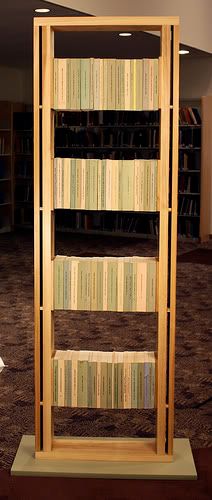
Check out my cousin Gabriel Troy's artwork using government documents. He says about this sculpture, "Federal Paperwork Burden": "I wanted to make these Government documents accessible and inaccessible at the same time. The books are fixed by tension without a back or shelf."

Principles for an Open Transition
Lawrence Lessig launched the website An Open Transition which offers President-elect Obama three principles to "guide the transition in its objective to build upon the very best of the Internet to produce the very best for government". These principles include: - No Legal Barrier to Sharing - No Technological Barrier to Sharing - Free Competition Read more about these principles, view the video, and sign the petition at open-government.us. Continue reading
50 Days to Government Information Liberation
When I started this long conversational march towards liberation, I thought libraries as institutions would be the first of those Gutenberg artifacts to be thrown onto our bonfire of change. But I now realize that this rush towards bibliographic revolution was just too glib. The exchange over the last two weeks -- here, here, and here -- reminds me again just how much of the intrinsic conflict between services and collections (as James puts it, is a false dichotomy) still frames our very foundations as professionals, even in a digital environment. I want to push this just a bit more. I fully recognize that a library world without collections is still very much in the distance of our professional perspective (much like the Pilgrim's "city on the hill"; something only realized by the approaching, never by the arrival.) And I fully recognize James' arguments for a collective bonding of local activism and global responsibility, or as he puts it so well, The networked environment means that for all intents and purposes, the local IS the global. Networked technologies like P2P, cheap servers, ever better indexing/search, metadata standards, harvesting and preservation infrastructures etc means that all libraries can have locally-important digital collections (and both human and networked services!!) that are globally accessible and able to be shared/reconfigured/repurposed with other local digital collections But this same networked ecosystem of digital political, social, cultural, economic and civic information ecosystems, in my opinion, does not automatically bestow the same kind of "authority" on these digital collections as they do (or might) on traditional repositories of paper and print civic information -- be they digital archives, libraries, institutes, centers, cooperatives, etc. I see governments at all levels binding their services and information sources more tightly together through the deployment of electronic government. The bibliographic gap created in the distribution chain of print and paper allowed many traditional libraries to grow their own local collections of government information that met the purposes of their users, and also allowed them to become ad hoc service providers either officially (picture patent and trademark libraries here) or unofficially (picture tax forms, explanations of medicare provisions, regulatory and legislative research.) In the digital world, this gap is eliminated. What is left is explanation, mediation, and organization of information sources that might be created by thousands of public and non-public institutions -- but for the most part will either remain with the producers or be delivered directly to the users by the producers (or a variety of third parties -- including libraries.) This is the kind of competitive information world (or the city on the hill) I see. I am not arguing for an either/or choice (we had this zero sum discussion earlier.) I am talking about how librarians deploy their limited capital, social and labor, within this evolving information ecology coming out of electronic government. It is about choices, yes. And one of those choices will be how much emphasis we should put on collections and how much on services. This new competitive environment among all these institutions, I argue, demands a different kind of government information librarianship. We said we will never win each other over -- but let our sparks of difference better illuminate our path as we slog our way towards that distant civic prominotory. This is fun. See you on Day 49 Continue reading
Bush’s exit to put new e-records system to the test
Following up on the report about NARA's Executive Office of the President (EOP) Electronic Records Archives (ERA) (http://freegovinfo.info/node/2178), here is a story that goes in to more detail, much of it quite scary.
- Bush's exit to put new e-records system to the test, By Mary Brandel, Computerworld, November 21, 2008.
Logan says part of the blame lies with federal agencies themselves, pointing to a GAO survey that concluded federal agencies have failed across the board to fulfill their records management obligations, "not out of malice or neglect but out of the nature of the volume of electronic communications and the time frame in which they have to do it," she says. "Anyone who's putting an optimistic face on the job is not being realistic." Optimism may be relevant from a technology point of view, Thibodeau acknowledges, but not from an information management point of view. "From my side of NARA, I don't deal with what's in the records, just whether we can get them into the system," he notes. "We allow the library staff to deal with the content." ...Logan says the problem of managing electronic records won't be resolved until the government agencies themselves do a better job of electronic records management, including classifying, de-duplicating and purging data through the use of systems such as archiving, records and policy management, content monitoring/filtering, and content analytics tools.A GAO report says, "NARA believes that if it cannot ingest the Bush records in a way that supports search and retrieval immediately after the transition, it may not be able to effectively respond to requests from the Congress, the new administration, and the courts for these records—a critical agency mission." (The National Archives and Records Administration’s Fiscal Year 2008 Expenditure Plan, September 2008, GAO-08-1105.) Continue reading
Should Obama ditch YouTube?
Chris Soghoian at CNet makes some interesting arguments for Why Obama should ditch YouTube (November 24, 2008). He says that the "use of YouTube and Google Analytics by the Obama transition team violates the privacy of Web site visitors and possibly even violates federal rules banning the use of permanent tracking cookies on government sites" and that the government should host its own videos.
...when a regular YouTube user views a video embedded in a blog or other third-party site, the user's cookie is automatically sent to YouTube's servers--even without the user clicking the play button. Given the widespread use of embedded videos, this gives Google, which owns YouTube, an even better idea of the surfing habits of millions of people around the world.He suggests: "By all means, use streaming video to reach the masses, but let the bits flow from government-owned servers (preferably without privacy-invading cookies). If bloggers wish to embed YouTube videos of the speech on their own sites, that is fine. But Obama shouldn't." I would go a step further by challenging the new President to use open-format standards for video and audio so that they can be preserved. Continue reading