
Berkman Center report on broadband deployment
Next Generation Connectivity: A review of broadband Internet transitions and policy from around the world, The Berkman Center for Internet & Society at Harvard University. (February 2010).
On July 14, 2009, the Federal Communications Commission (FCC) announced that the Berkman Center for Internet & Society at Harvard University would conduct an independent expert review of existing literature and studies about broadband deployment and usage throughout the world and that this project would help inform the FCC's efforts in developing the National Broadband Plan. The Berkman Center's Final Report was submitted to the FCC on February 16, 2010. ... Our most prominent initial findings, confirmed and extended in this final draft, were that U.S. broadband performance in the past decade has declined relative to other countries and is no better than middling. Our study expanded the well known observation with regard to penetration per 100 inhabitants, and examined and found the same to be true of penetration per household; subscriptions for mobile broadband; availability of nomadic access; as well as advertised speeds and actually measured speeds; and pricing at most tiers of service.The Center has made the full datasets behind their research available for download. Continue reading
Incompatible DRM for ebooks
Digital Rights Management (DRM) techniques are bad enough when applied to digital content, but this article notes that when there is not even a standard for DRM, the difficulties and problems that DRM creates are multiplied:
- E-books need a common language, By Troy Wolverton, San Jose Mercury News, (02/14/2010) I never need to worry about whether I can read a book. As long as a book's a book, that is — printed on paper, in English. I know I can pick it up and read it no matter how long it sits on my shelf after I bought it. But as we move into the era of e-books, that assumption no longer holds.
- Digital handcuffs for Apple ebooks?, by Carolyn Kellogg, Los Angeles Times "Jacket Copy" blog. (February 16, 2010) Apple's old digital rights management software (DRM), FairPlay, is slated to make a comeback with the e-books it will be selling on its iBook Store. While music users have been free of these "digital handcuffs" for the last year, Alex Pham reports that readers will not be.
40 percent in US lack home broadband
The new report from the National Telecommunications And Information Administration (NTIA) on broadband availability in the U.S. is now available. The most dramatic finding is that approximately 40 percent of all persons in the U.S. have no broadband access at home.
- DIGITAL NATION: 21st Century America’s Progress Towards Universal Broadband Internet Access "An NTIA Research Preview" (February 2010). (PDF, 1.3 MB)
White House uses ebook formats
The Economic Report of the President is available from the White House web site in 3 formats: PDF, Kindle, and the open ePub format which Barnes & Noble's Nook, Sony's Reader, and other ebook-reader-software can use. The epub format, being an open, non-proprietary standard is, potentially, much easier to preserve for the long-term than proprietary formats like Kindle and PDF. I looked at the Kindle version, the ePub version using the Stanza application on a Macintosh laptop and on an iPhone, and the PDF version on my laptop. The PDF looks the way the printed book looks with accurate page formatting and layout. The ePub and Kindle formatting is not perfect, but is readable. Table of Contents links did not work at all in Stanza, but did on the Kindle -- including links to individual statistical tables in the appendix. The PDF version has a navigation sidebar for the chapters, but not for the statistical tables within the appendix. Statistical tables are complete and accurately formatted in the epub and Kindle versions. They are tiny on the iPhone, but re-sizable, so the tables are readable. I doubt many people will want to read those tables on their phones, however. On the Kindle, the statistical tables are not resizable and I found them very hard to read, even when I rotated them to "landscape" orientation. The tables did not appear at all in the Stanza app on the Macintosh. This is a welcome first step for making digital government information more widely available. The digital publishing community needs to do more work on the open ePub format to handle formatting and links better and the hardware and software manufacturers need to work toward better usability. After working recently to produce a book in Kindle, epub, and PDF formats, I know that publishers (including whoever formatted these for ebook readers [GPO?]) can do a better job even now with what they have. But, this is a good first step. See also: White House embraces e-book readers, By Nate Anderson, ars technica (February 15, 2010). Continue reading
International Amateur Scanning League (IASL) to the rescue!
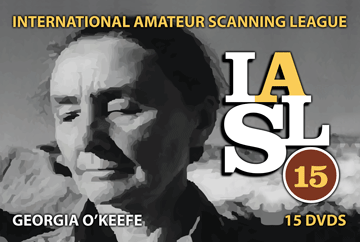 Carl Malamud announced yesterday the inaugural meeting of the International Amateur Scanning League (IASL) (I'm already imagining cool swag!). Malamud is taking FedFlix program to the streets! Fedflix, a joint venture between the National Technical Information Service and Public.Resource.Org, digitizes NTIS video and makes them available on YouTube, the Internet Archive, and the public.resource.org Stock Footage Library.
Well now a gang of volunteers including members of DC CopyNight and Smithsonian employees working on their own time are going to the National Archives and Records Administration (NARA) and copying over 1,500 DVDs to be uploaded to the net.
Malamud said:
Carl Malamud announced yesterday the inaugural meeting of the International Amateur Scanning League (IASL) (I'm already imagining cool swag!). Malamud is taking FedFlix program to the streets! Fedflix, a joint venture between the National Technical Information Service and Public.Resource.Org, digitizes NTIS video and makes them available on YouTube, the Internet Archive, and the public.resource.org Stock Footage Library.
Well now a gang of volunteers including members of DC CopyNight and Smithsonian employees working on their own time are going to the National Archives and Records Administration (NARA) and copying over 1,500 DVDs to be uploaded to the net.
Malamud said:
What makes this grassroots digitization effort so remarkable is that it has the full support of the government. Indeed, David Ferriero, the U.S. Archivist, joined me in the initial meeting where we taught volunteers how to rip DVDs!Kudos to Malamud and the IASL! And this makes me think that more libraries and librarians should be doing the same thing for govt documents. Why not set up your own scanning operations in your depository library (Book Liberator or DIY Book Scanner can show you how to digitize on the cheap!) and then deposit those scans into the Internet Archive's US Documents Collection (don't forget to follow FDLP digitization standards!). Scans could also be ingested into FDSys (when they've got that capability working ;-)). So get to it; what are you waiting for?! Continue reading