
State Agency Databases Activity Report 5/6/2012
Activity at the State Agency Databases Across the Fifty States project continues. For a blow by blow description of the changes over the last two weeks, see http://tinyurl.com/statedbs14d. Here are some highlights: DATABASES ADDED GEORGIA (Chris Sharpe) Search General Assembly Audio/Video - "Search through the sound tracks of audio and video files from the Georgia State Legislature." From 2001-2008 MAINE (Alex Burnett) Bill Tracking and Text Search - Database of bills in the Maine Legislature since the 112th (1985) Legislature. Includes basic information about bills. MICHIGAN (Michael McDonnell) Trail or Pathway Search - You can search for information on a trail by name, by county, by feature or accommodation, or activity. You can also search from an interactive map. The site does not include many small county and city trails. Be sure you reset the search parameters after each search. TEXAS (Ann Ellis) Manufactured Housing Report Options - For those interested in information about manufactured homes in the state of Texas, this database provides records for ownership history, retailer data, tax information, and title, license, and inspection reports. UTAH (Susanne Caro) Statewide Warrant Search - First and last name required for searching The Utah Statewide Warrants file (SWW) is designed to provide information on individuals wanted in the state of Utah. The warrant information comes from courts that send in data to the Utah Criminal Justice Information System (UCJIS) via electronic transfer, which means that the data viewed is the direct result of court activity. As with any warrant system, caution must be used when viewing data from this file. Accuracy and timeliness are critical factors when acting on warrant information, as this system is dependent upon timely entry and removal of records by the courts. Continue reading
Government Issue: Comics for the People, 1940s-2000s
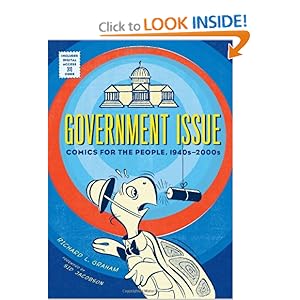 How did I miss this when it was published in late 2011? Government Issue: Comics for the People, 1940s-2000s by Richard Graham looks to be a valuable addition to any library's collection. Richard Graham is an associate professor and media services librarian at the University of Nebraska-Lincoln. He created and curates UNL’s digital collection of government comics.
Since the 1940s, federal and state government agencies have published comics to disseminate public information. Comics legends Will Eisner and Milton Caniff produced comics for the army. Li’l Abner joined the navy. Walt Kelly’s Pogo told parents how much TV their kids should watch, Bert the Turtle showed them how to survive a nuclear attack, and Dennis the Menace took “A Poke at Poison.” Smokey Bear had his own comic, and so did Zippy, the USPS mascot. Dozens of artists and writers, known and unknown, were recruited to create comics about every aspect of American life, from jobs and money to health and safety to sex and drugs. Whether you want the lowdown on psychological warfare or the highlights of working in the sardine industry, the government has a comic for you! Government Issue reproduces an important selection of these official comics in full-reading format, plus a broad range of excerpts and covers, all organized chronologically in thematic chapters. Earnest, informational, and kitschy, this outstanding collection is the ultimate comics vox populi.[HT BoingBoing!] Continue reading
Lunchtime listen: LC National Jukebox, Smithsonian Folkways and Animal Cams
Just finishing up the first Webinar hosted by the ALA Government Documents Round Table (GODORT) entitled "Lions, and Podcasts, and Videos! Oh My!" Kathryn Yelinek from Bloomsburg University did a great job in showcasing audio-visual resources available from the US Government. Check out the following:
- Library of Congress National Jukebox
- Smithsonian Folkways
- National Gallery of Art podcasts
- National Zoo Animal Cams
While tangible print documents have dominated traditional government sources, the United States government has always produced information in a variety of formats. This session is intended to introduce librarians to the rich variety of online government audiovisual material. Come and learn how to point your patrons to folk music recordings, historical videos, and more (there might be lions!) About the Presenter: Kathryn Yelinek received her MLIS from the University of Pittsburgh and her MSIT from Bloomsburg University of Pennsylvania. For the past seven years, she has served as Coordinator of Government Documents for Bloomsburg University of Pennsylvania. While still a bibliophile at heart, she's becoming more aware of the educational benefits of audiovisual material.Continue reading
New Link Rot report from Chesapeake
For the past five years, the Georgetown Law Library and the Chesapeake Digital Preservation Group have been doing doing studies on "link rot." This year, they discovered that "link rot has increased to 37.7 percent within five years."
- "Link Rot" and Legal Resources on the Web: A 2012 Analysis by the Chesapeake Digital Preservation Group.
- Georgetown Law Library Finds 38 Percent of Online Documents Disappear from Web Pages Within Five Years, press release, Georgetown University (April 25, 2012).
10% in 2008 13% in 2009 25% in 2010 31% in 2011 36% in 2012Cumulative link rot of state government URLs (.state.__.us) were almost as bad: 10.8% in 2008 15.8% in 2009 32.1% in 2010 30.4% in 2011, and 33.8% in 2012. The total cumulative link rot for all URLs was 37.7% in 2012. Another way of looking at this is that, of the documents the Chesapeake Project has preserved, only only 62.3% were still available at their original URL as of the 2012 study. This year's report includes two samples of URLs. The first sample includes 579 URLs that Chesapeake captured during 2007 and 2008. They use this sample to examine how link rot changes over time. The second sample is a new and represents the full content of the Chesapeake archive at the time the study was conducted. Using this second, broader sample the study reports a link rot rate of 25.9%. For libraries that rely on pointing to URLs rather than preserving information in their own digital libraries, the new report from the Chesapeake Project provides sobering, factual data on the reliability of that strategy. Continue reading
Tool for verifying federal social media accounts
The General Services Administration has launched two new sites: one for federal agencies to register their social media accounts and one for users to verify if a social media account is really an official federal account.
- GSA tool lets people verify genuine federal social media accounts, By Alice Lipowicz, FCW (Apr 27, 2012). Federal agencies need help tracking their social media accounts, and citizens need help verifying which government accounts are authentic. Now the General Services Administration has stepped in to address both of those concerns with a new online solution.
- Verify federal U.S. government social media accounts, USA.gov The government uses social media tools like Twitter, Facebook and YouTube to connect with people and communicate official information, so it's important to know if a social media account is really managed by the government. We're currently working on a tool that will let you verify if a social media account is officially managed by the U.S. government. This tool will be available soon on this page.
- Check & Register: Federal Social Media Accounts, by Justin Herman, HowTo.gov (Apr. 26, 2012). GSA has built a federal social media registry -- a government-wide solution that gives the public a way to verify whether a social media account is official. It also provides a place for agencies to register their accounts centrally so they don't have to build a solution within each agency.