
ERIC suspends some full text over privacy concerns
I'm not sure how long this has been going on, but in trying to retrieve a report from the Education Resources Information Clearinghouse (ERIC), I received this "error" message:
Dear ERIC Community, We have currently disabled access to many ERIC full-text PDFs due to the discovery of personally identifiable information in some documents. A team is in place to check each PDF to see if it contains personally identifiable information. Due to the quality of many of the documents, a large portion of the search has to be done by hand. This will take several weeks, but our primary concern is to protect the privacy of individuals. To minimize the burden on our users, we will prioritize searching the PDFs that users request. If you would like to request a PDF to be returned online, please fill out this form, which requires only the document’s ERIC record number and your email address. Full-text PDFs will be returned on a rolling basis. We will be posting the list of newly released documents here. We are sorry for the inconvenience and want to thank you for bearing with us through this unexpected delay. The ERIC TeamIt seems like a responsible enough message and they are trying to assist researchers who need documents. It would have been nice if the message had a date stamp so we could see how long it will take ERIC to rectify this situation. I'm also wondering about the status of ERIC fiche collections. Wonder if we'll see withdrawal requests from ERIC and whether that would wind up highlighting the personal information they're trying to withdraw. Continue reading
State Agency Databases Activity Report 1/27/2013
This week at the State Agency Databases project at http://wikis.ala.org/godort/index.php/State_Agency_Databases: ORPHANS: AND THEN THERE WERE SIX With the pending adoption of the District of Columbia, we now have six states up for adoption:
- Florida
- Hawaii
- Kansas
- Maryland
- Minnesota
- Oklahoma
Public talk: “Gone Today, Here Tomorrow: The Future of Government Information and the Digital FDLP”
I had the distinct honor to be invited to speak at the University of Washington Libraries on thursday, January 24, 2013. I want to thank Cass Hartnett, the Northwest Government Information Network, the UW Information School, the UW Association of Library and Information Science Students (ALISS), and the University of Washington Libraries for allowing me the opportunity to talk publicly about the future of the Federal Depository Library Program (FDLP). the audio for my talk can be downloaded from the UW Library digital archive or streamed below from the Internet Archive. that is all.
We’re at the very beginning of the digital era where tools, policies, best practices, etc are all in flux. In many ways, we’re at the age of new metaphors needed to describe what it is that we as librarians do on a daily basis. I'd like to talk about the underlying historical ideals of the FDLP, discuss how those ideals have been under fire from both within and without the library community and argue that those ideals applied to today's new information metaphors give us the best chance at access to and long-term preservation and assurance of govt information. Then I’ll talk about some of the digital collection strategies that I’ve found to be successful and then conclude with a bit about collaboration and to-dos.
All 100 Senators are now on Twitter
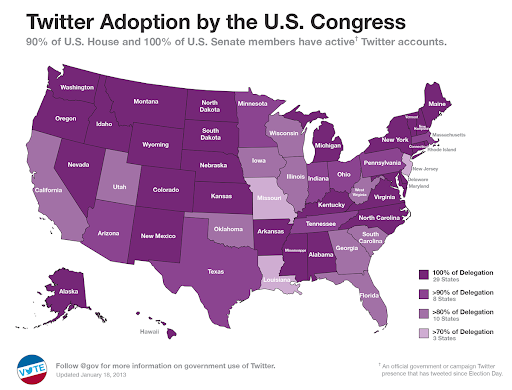
Twitter announced last Friday that all 100 members of the Senate as well as 90% (398 members) of the House of Representatives are on Twitter. In the 112th Congress only 44% of Senators were on Twitter. House use of Twitter has also increased from 35% to 90% (398 representatives). Twitter also announced that Michelle Obama will be tweeting from @FLOTUS about her life as First Lady.
- An entire Senate on Twitter. Really. By Joseph Marks, NextGov (January 23, 2013). Raw numbers can be misleading where Twitter is concerned. The federal tech sphere alone is littered with rarely used Twitter accounts. The Senate’s story seems different, though. A quick review of about 30 senators’ handles revealed no slackers. All of the senators -- or usually their staffs, of course -- are tweeting at least several times a week but, more importantly, a solid proportion of those tweets include content that would actually be valuable to people following the senators’ activities, such as links to legislation the lawmaker introduced, notes on committee work and alerts about media appearances.
- 100 Senators and the 57th Inauguration, Twitter Blog (January 18, 2013).
- US Senate: A public list by Twitter Government: "Principal Accounts of Members of the U.S. Senate (a mix of campaign and government accounts)."
- US House: A public list by Twitter Government: "Principal Accounts of Members of the U.S. House of Representatives (mix of campaign/govt accounts)".
 Continue reading
 OMB Watch now Center for Effective Government
The Center for Effective Government, a nonprofit research and advocacy organization, was formed as OMB Watch in 1983 to lift the veil of secrecy shrouding the White House Office of Management and Budget (OMB). In January 2013, OMB Watch became the Center for Effective Government.
- Center for Effective Government (website).
- Government Matters (newsletter)
- The Fine Print (blog)
- RSS feeds
- twitter.com/foreffectivegov
- facebook.com/foreffectivegov