
Home » Doc of the day (Page 26)
Category Archives: Doc of the day
Hot new CRS reports in the news
I've got a google search alert set up for "CRS report" OR "Congressional Research Service" and thought I'd share the CRS reports in my most recent alert. If you're not familiar with this service, it's a handy way to keep track of issues or subjects. Go to http://www.google.com/alerts to set up alerts, or do a search on google news and scroll down to the bottom of the page to create an alert for your search. Here's the latest CRS reports in the news:
- Taiwanese air force faces plane shortage by 2020. Taipei Times. "The annual report by the Congressional Research Service, entitled Taiwan: Major US Arms Sales Since 1990 — which Defense News has called “required reading inside Taiwan defense circles and among US defense officials working with the island’s military” — provides a detailed analysis of US arms sales to Taiwan over more than two decades."
- The Domestic Terrorist Threat: Background and Issues for Congress. CRS Report R41780. Posted on the FAS Secrecy News site.
- eNewsUSA: CRS Report On GHG Emissions & Canadian Oil Sands
- China's Stranglehold on Rare Earths to Loosen as North American Production Facilities Come Online. Finance.yahoo.com. "According to a Congressional Research Service (CRS) Report in April China currently produces 97 percent of the world's rare earth oxides." I found the 2011 CRS report posted on OpenCRS but the 2012 report has not been made public yet.*
- Fox Mangles Data To Claim "The Poor" Are Getting "Richer". Media Matters. "The CRS report notes that "although the rank of the United States differs somewhat from one study to the next, as discussed below, the United States typically is found to be among the least mobile of the advanced economies." [Congressional Research Service, 3/7/12]" The U.S. Income Distribution and Mobility: Trends and International Comparisons March 7, 2012 - R42400 posted on OpenCRS. Also posted on Secrecy News.
What’s hot in government documents? Library Journal publishes 2011 Notable government documents
 Library Journal has just published their annual list of Notable Government documents, "Notable Government Documents 2011: Past as Prologue". This list of notable Federal, State, Local and International documents -- put together each year by ALA's Government Documents Round Table -- is a collaborative effort by the documents community to promote awareness and acquisition of government publications by libraries and use by library patrons. The list highlights the depth and breadth of the work of our governments. Check them out -- and make sure your library has them in their collections! Continue reading
CRS report on Legal Issues of Same-Sex Marriages
From Secrecy News: "The laws and policies governing same-sex marriages were exhaustively surveyed in a newly updated report from the Congressional Research Service."
- Same-Sex Marriages: Legal Issues, by Alison M. Smith, Congressional Research Service RL31994, (May 9, 2012) [PDF at www.fas.org].
Government Issue: Comics for the People, 1940s-2000s
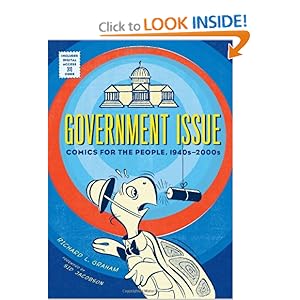 How did I miss this when it was published in late 2011? Government Issue: Comics for the People, 1940s-2000s by Richard Graham looks to be a valuable addition to any library's collection. Richard Graham is an associate professor and media services librarian at the University of Nebraska-Lincoln. He created and curates UNL’s digital collection of government comics.
Since the 1940s, federal and state government agencies have published comics to disseminate public information. Comics legends Will Eisner and Milton Caniff produced comics for the army. Li’l Abner joined the navy. Walt Kelly’s Pogo told parents how much TV their kids should watch, Bert the Turtle showed them how to survive a nuclear attack, and Dennis the Menace took “A Poke at Poison.” Smokey Bear had his own comic, and so did Zippy, the USPS mascot. Dozens of artists and writers, known and unknown, were recruited to create comics about every aspect of American life, from jobs and money to health and safety to sex and drugs. Whether you want the lowdown on psychological warfare or the highlights of working in the sardine industry, the government has a comic for you! Government Issue reproduces an important selection of these official comics in full-reading format, plus a broad range of excerpts and covers, all organized chronologically in thematic chapters. Earnest, informational, and kitschy, this outstanding collection is the ultimate comics vox populi.[HT BoingBoing!] Continue reading
New Link Rot report from Chesapeake
For the past five years, the Georgetown Law Library and the Chesapeake Digital Preservation Group have been doing doing studies on "link rot." This year, they discovered that "link rot has increased to 37.7 percent within five years."
- "Link Rot" and Legal Resources on the Web: A 2012 Analysis by the Chesapeake Digital Preservation Group.
- Georgetown Law Library Finds 38 Percent of Online Documents Disappear from Web Pages Within Five Years, press release, Georgetown University (April 25, 2012).
10% in 2008 13% in 2009 25% in 2010 31% in 2011 36% in 2012Cumulative link rot of state government URLs (.state.__.us) were almost as bad: 10.8% in 2008 15.8% in 2009 32.1% in 2010 30.4% in 2011, and 33.8% in 2012. The total cumulative link rot for all URLs was 37.7% in 2012. Another way of looking at this is that, of the documents the Chesapeake Project has preserved, only only 62.3% were still available at their original URL as of the 2012 study. This year's report includes two samples of URLs. The first sample includes 579 URLs that Chesapeake captured during 2007 and 2008. They use this sample to examine how link rot changes over time. The second sample is a new and represents the full content of the Chesapeake archive at the time the study was conducted. Using this second, broader sample the study reports a link rot rate of 25.9%. For libraries that rely on pointing to URLs rather than preserving information in their own digital libraries, the new report from the Chesapeake Project provides sobering, factual data on the reliability of that strategy. Continue reading
Latest Comments