
Home » Articles posted by James A Jacobs (Page 80)
Author Archives: James A Jacobs
NAPA releases report on GPO
The National Academy Of Public Administration has released its report on the Government Printing Office.
- Rebooting The Government Printing Office: Keeping America Informed in the Digital Age, A Report by a Panel of the National Academy Of Public Administration for the U.S. Congress, Congressional Research Service, and the Government Printing Office. National Academy Of Public Administration, Washington, DC (January 2013). Congress mandated that the National Academy of Public Administration (the Academy) conduct a broad operational review of GPO. The Academy formed a five-member Panel of Fellows to conduct a ten-month study of the agency’s current role, its operations, and its future direction.
- III-3: Preservation of the Legacy (Tangible) Government Collection
- III-4: Preservation of the Digital Government Collection
- III-5: Government Information Dissemination and Access
Now may be the time for GPO to revisit charging the public for access to FDsys content. The Academy convened a forum of experts on printing and publishing where this topic was discussed extensively. Participants noted that technologies for online payments have progressed to the point that they cost very little to administer. Also, the public is becoming accustomed to paying fees for government services that used to be free (such as admittance to National Parks). Rather than charge a publication price, GPO could explore charging a small user fee to recoup the cost of providing access to government information on FDsys, or allowing users to view documents for free, and charging for document downloads. Forum participants also discussed the possibility of GPO exploring opportunities for repackaging files and content in different ways and making them available for sale to the public.This model (as the report notes) was tried before with GPO Access and failed. We would argue that it failed not because the "technologies of online payments" were inadequate at the time, but because attempting to charge fees for information that was also available without fees was a fundamentally flawed approach. (We have written about this issue many times. See for example: Government Information in the Digital Age: The Once and Future Federal Depository Library Program and Privatization of GPO, Defunding of FDsys, and the Future of the FDLP.) There is much more in the report and it deserves careful scrutiny. Continue reading
Pilot project: free online-access to court opinions
Access to Court Opinions Expands. Administrative Office of the U.S. Courts (January 31, 2013).
A pilot project giving the public free, text-searchable, online-access to court opinions now is available to all federal appellate, district and bankruptcy courts. The Judicial Conference, the policy-making body of the Federal court system, approved national implementation of the project with the Government Printing Office, Federal Digital System (FDsys), which provides free access to publications from all three branches of federal government via the Internet. The pilot project pulls opinions nightly from courts’ Case Management/Electronic Case Files (CM/ECF) systems and sends them to the GPO, where they are processed and posted on the FDsys website. The functionality to transfer opinions to FDsys is included in the latest release of CM/ECF which is now available to all courts. Twenty-nine courts participated in the original pilot, and now, all courts may opt to participate in the program. Access to judicial opinions through FDsys allows the Judiciary to make its work more easily available to the public. Collections are divided into appellate, district or bankruptcy court opinions and are text-searchable across opinions and across courts. FDsys also permits embedded animation and audio. Presently, more than 600,000 opinions dating back to 2004 are available. Opinions from the pilot are already one of the most heavily used collections on FDsys, with millions of retrievals each month.Continue reading
Coffee Break Listen: Open PACER!
Steve Schultze, Princeton University, Associate Director at the Center for Information Technology Policy, gave this talk as part of a series of 3-minute lightning talks on transparency hosted on Capitol Hill by the Advisory Committee on Transparency, a project of the Sunlight Foundation.
- My Bill to #OpenPACER in memory of #aaronsw -- Open for Comment and Available on Github, by Steve Schultze. Freedom to Tinker (February 1, 2013). (video and transcript with links and downloadable slides). ...the courts offer electronic records through the PACER web site, which charges for search results, docket lists, and documents. ...PACER is making a killing, with $120 million dollars in revenue for 2012. Even with a highly inefficient system architecture, they only manage to spend about $20 million dollars on PACER expenses per year. Where does the rest of the money go? They spend it on other stuff. This is illegal. In 1992, Congress passed a law saying that the courts could charge only to recoup costs. Ten years later, Congress strengthened that law and said that it expected the courts to move to a free system. PACER fees have increased 42% since then. ...Open PACER is a bill that, once and for all, mandates that the courts provide free access to our public record. The bill is open for comment at openpacer.org. It is written in GPO-compliant Legislative XML, which anyone can edit and submit for incorporation via a tool called github.
Having Trouble with New American Factfinder? GPO suggests a workaround browser problems
The "workaround" is to clear your browser's cache, cookies, and history. The Census Bureau also suggests viewing the site in either Internet Explorer 9 or 8. The Bureau and its contractor should be really, really embarrassed about this and fix it quickly.
- Workaround Solution for Redesigned American Factfinder Browser Issues. FDLP Desktop (31 January 2013).
The U.S. Census Bureau has brought to our attention that the newly redesigned American FactFinder does not render properly in some Web browsers. Users have reported issues with various versions of Mozilla Firefox (FF) and Internet Explorer (IE).
The Census Bureau is investigating the matter. In the meantime, their recommendation is to clear the browser's cache, cookies, and history as a temporary solution. In addition, they recommend viewing the site in either IE 9 or 8. If issues are encountered, the following instructions are specific to IE 8 and up.
- Click on the "Tools" icon.
- Select "Internet Options".
- Under the "General" tab, click on the "Delete" button under "Browsing history".
- Select the following:
- Temporary Internet files
- Cookies
- History
- Deselect:
- "Preserve Favorites website data"
- Click on the "Delete" button.
To clear the browser cache, cookies, and history for other browsers, visit the American FactFinder FAQ or check the browser's Web site for browser-specific instructions.
Be advised that clearing your browser's cache, cookies, and history may impact saved sessions for other Web services.
All 100 Senators are now on Twitter
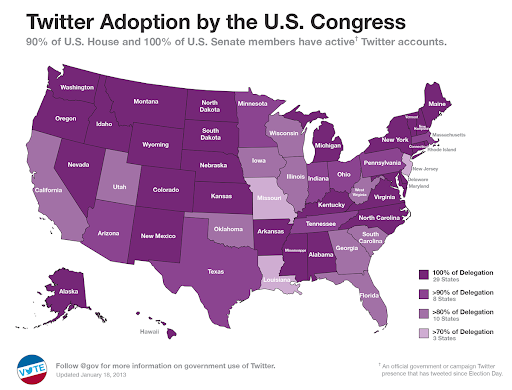
Twitter announced last Friday that all 100 members of the Senate as well as 90% (398 members) of the House of Representatives are on Twitter. In the 112th Congress only 44% of Senators were on Twitter. House use of Twitter has also increased from 35% to 90% (398 representatives). Twitter also announced that Michelle Obama will be tweeting from @FLOTUS about her life as First Lady.
- An entire Senate on Twitter. Really. By Joseph Marks, NextGov (January 23, 2013). Raw numbers can be misleading where Twitter is concerned. The federal tech sphere alone is littered with rarely used Twitter accounts. The Senate’s story seems different, though. A quick review of about 30 senators’ handles revealed no slackers. All of the senators -- or usually their staffs, of course -- are tweeting at least several times a week but, more importantly, a solid proportion of those tweets include content that would actually be valuable to people following the senators’ activities, such as links to legislation the lawmaker introduced, notes on committee work and alerts about media appearances.
- 100 Senators and the 57th Inauguration, Twitter Blog (January 18, 2013).
- US Senate: A public list by Twitter Government: "Principal Accounts of Members of the U.S. Senate (a mix of campaign and government accounts)."
- US House: A public list by Twitter Government: "Principal Accounts of Members of the U.S. House of Representatives (mix of campaign/govt accounts)".
 Continue reading
Latest Comments