
ALA Creates Federal Depository Library Program Issues “Community and Resources Page
via INFOdocket.com From the ACRL Insider Blog:
ALA has created a community within ALA Connect so that ALA members from any interested unit or division can discuss the issues surrounding the Federal Depository Library Program (FDLP). This is a way toward aiding the ALA in reaching consensus on the future of the FDLP or at the very least, having a better understanding of the various perspectives held by members on these topics. Additionally, ALA has created a webpage where various information related to this topic and the recent happenings surrounding this issue are available. If you feel that there are any items missing from this list, please let us know! We want this compilation to be as inclusive as possible of official communication. If you have questions or commnets, please contact Jessica McGilvray, Assistant Director of the ALA Washington Office.Continue reading
Roundup of Government Info News and New Resources
Time once again for a selection of news and new resources that we hope will be an interest to the FGI community. The posts are from INFOdocket.com (@infofodocket) where we compile and post new items daily from a variety of resources. 1. “Obama Wants Better Digital Archive of Federal Records” + Full Text of Presidential Memorandum 2. Now Available: EPA Releases Formerly Confidential Chemical Information 3. San Antonio, TX: New Online Database: Historical Election Results are Digitized 4. Statistics Canada to Make All Online Data Free 5. UK Parliament: MPs to Investigate Library Closures 6. TR Center Officially Launches the Theodore Roosevelt Digital Collection 7. Idaho: Libraries to Adjust to New Internet Filtering Law 8. U.S.: National Archives Trust Fund To Sell Copies of the 1940 Census (Digital & Microfilm Versions) Available 9. All Thing Preservation: New NARA (National Archives) Twitter Stream & Tumblr Page 10. U.S. History: Senator George Mitchell Oral History Project Debuts Online 11.New Social Media Resource: “PolitickerUSA is the Best Way to Track Politicians’ Tweets” 12. Video Now Online of NARA’s “What’s Next in Social Media” Forum 13. Child Welfare Information Gateway — State Guides & Manuals Search 14. GPO Releases Its First App 15. New UN Database Available: Expert Panel Launches Tool to Fight Arbitrary Deprivation of Freedom 16. State of Minnesota Posts Franchise Disclosure Documents (FDD) 17. U.S. Government: USAID Launches New GeoCenter 18. Public Access to Indiana’s Historic Sanborn Maps Provides Treasure Trove of Information 19. California: More than 13,000 Online Maps Provide Historic View of State 20. UNESCO’s Global Open Access Portal Now Online Continue reading
New Government Report Looks at Broadband Adoption in U.S. and Shows Digital Divide Persists
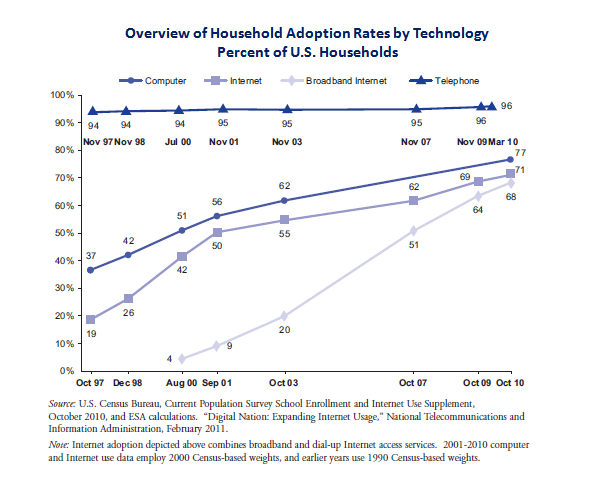
The Economics and Statistics Administration (ESA) and the National Telecommunications and Information Administration (NTIA) released a report today entitled Exploring the Digital Nation: Computer and Internet Use at Home (PDF). This report investigates broadband Internet use in the United States and finds that disparities continue to exist in broadband Internet adoption among demographic and geographic groups. The report also delves into the reasons why households have not adopted broadband Internet.Broadband internet adoption has increased substantially in only a few years, rising to 68% of households in 2010 from only 51% of households three years earlier and from 64% in 2009, the last time ESA and NTIA looked at these issues.
While this points to progress, a digital divide still exists between different racial and ethnic groups and between urban and rural areas in the United States. Broadband adoption rates varied substantially between different racial and ethnic groups, with 81% of Asian and 72% of White households having broadband Internet access, compared to only 55% and 57% of Black and Hispanic households. The urban-rural divide is also wide, with 70% of urban households having broadband Internet access compared to only 57% of rural households. Socio-economic differences, such as income and education, explain much – but not all – of this divide.
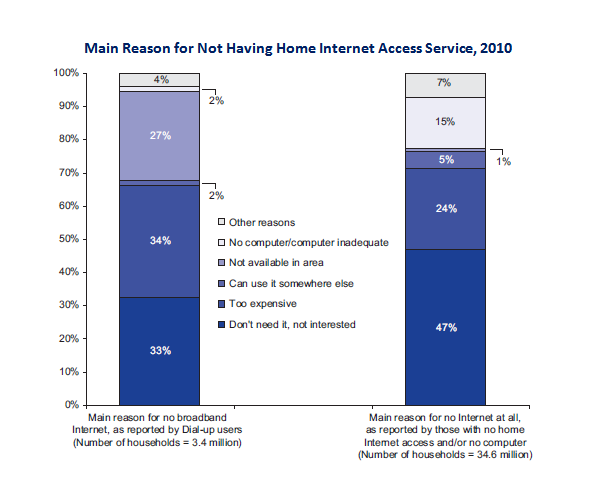
Here is what we know: Households that do not subscribe to any Internet service—dial-up or broadband —cited as the main reasons a lack of need or interest (47%); lack of affordability (24%); and an inadequate computer (15%). However, 27% of dial-up users -- a rapidly declining group of users --- indicated that they did not have broadband internet access service in their area.
Access the Full Text Report (72 Pages; PDF)
Overall
- Sixty-eight percent of American households used broadband Internet in 2010, up from 64 percent in 2009. Only three percent of households relied on dial-up access to the Internet in 2010, down from five percent in 2009. Another nine percent of households had people who accessed the Internet only outside of the home.
- All told, approximately 80 percent of American households had at least one Internet user, whether inside or outside the home and regardless of technology type used to access the Internet.
Differences in Household Broadband Adoption
- Cable modems and DSL were the leading broadband technologies for home Internet adoption, with 32 percent and 23 percent of households, respectively, using these services.
- Households with lower incomes and less education, as well as Blacks, Hispanics, people with disabilities, and rural residents, were less likely to have Internet service at home.
- Eighty-one percent of Asian households and 72 percent of White households had broadband at home, compared to 57 percent of Hispanic households and 55 percent of Black households.
- Seventy percent of urban households had broadband at home, compared to 57 percent of rural households.
- Households with school-age children were more likely to have broadband at home (78 percent) than the national rate. Older householders, particularly those ages 65 and older (45 percent), were less likely to have broadband at home.
- Less than half (43 percent) of households with annual incomes below $25,000 had broadband access at home, while 93 percent of households with incomes exceeding $100,000 had broadband.
Role of Socio-Economic Factors
- Average broadband adoption in 2010 varied by state from about half (52 percent) of all households to 80 percent.
- Socio-economic differences do not explain the entire broadband adoption gap. For example, after accounting for socio-economic and geographic factors, Black and Hispanic households still lag White households in broadband adoption by 11 percentage points, though the gap between Asian and White households disappears.
- After accounting for socio-economic and demographic factors, rural households still lag urban households in broadband adoption by five percentage points.
- In contrast, differences in socio-economic characteristics do explain a substantial portion but not all of the broadband adoption lag among people with disabilities.
Reasons for Not Subscribing to Broadband at HomeAccess the Full Text Report (72 Pages; PDF) Continue reading
- The main reasons cited for not having Internet access at home were a lack of interest or need (47 percent), the expense (24 percent), and the lack of an adequate computer (15 percent).
Long-term Trends in Internet and Computer Use
- Not surprisingly, individuals without broadband service at home relied on locations such as public libraries (20 percent) or other people’s houses (12 percent) to go online.
- Between 2001 and 2010, broadband Internet use at home, regardless of technology type, rose from 9 percent to 68 percent of households.
- Between 1997 and 2010, Internet use among households, regardless of technology type, rose from 19 percent to 71 percent.
- More than three quarters (77 percent) of American households had a computer at home in 2010, up from 62 percent in 2003.
New From NARA: National Archives Publishes National Registry of Controlled Unclassified Information
Reposted with Permission from INFOdocket.com From NARA:
On November 4, 2010, President Obama signed Executive Order 13556, "Controlled Unclassified Information (CUI)," and designated the National Archives and Records Administration as the Executive Agent "to implement this order and oversee agency actions to ensure compliance with this order." On November 4, 2011, as required by this Executive Order, the National Archives Controlled Unclassified Information Office established a publically available registry reflecting the initial categories and subcategories of unclassified information that require dissemination or safeguarding controls consistent with and pursuant to law, regulation, and Government-wide policy. This registry is online. [Clip] The CUI program will be implemented in phases based on compliance plans and target dates to be submitted by executive agencies and departments. When fully implemented, the CUI program will require executive departments and agencies to exclusively use these categories for controlling and marking such unclassified information. The National Archives will consult with the agencies and the Office of Management and Budget and then set implementation deadlines for CUI, to include for applying standardized CUI markings. Currently, there are more than 100 different policies for such information across the Executive branch. This plethora of policies has created inefficiency and confusion, leading to a patchwork system that fails to adequately safeguard information requiring protection, and unnecessarily restricts information sharing by creating needless impediments.Learn More ||| Access the Registry Read the Complete Announcement Continue reading
NIST Goes Public with Cloud Computing Tech Road Map
The National Institute of Standards and Technology has released for public comment a draft “road map” designed to foster federal agencies’ adoption of cloud computing. The road map also will support private-sector cloud efforts, improve the information available to decision-makers, and facilitate the continued development of the cloud computing model, NIST officials said. "U.S. Government Cloud Computing Technology Roadmap, Release 1.0" (NIST Special Publication 500-293) is designed to support the secure and effective adoption of the cloud computing model by federal agencies. The public comment period is open through Dec. 2. [Clip] The draft publication defines high-priority requirements for standards, official guidance and technology developments that need to be met for agencies to accelerate their migration of existing IT systems to the cloud computing model.Read the Complete GCN Article See Also: NIST Releases Draft Cloud Computing Technology Roadmap for Comments (via NIST) See Also: Final Version of NIST Cloud Computing Definition Published (October 25, 2011) See Also: NIST Cloud Computing Program Direct to Documents: "U.S. Government Cloud Computing Technology Roadmap, Release 1.0" (NIST Special Publication 500-293) The NIST Definition of Cloud Computing (NIST Special Publication 800-145). Continue reading
Latest Comments