
Recycle your PACER documents
Here at Stanford, the campus recently enjoyed the excitement that is Recyclemania. (Stanford actually won the Gorilla Prize!) In the spirit of Recyclemania, I want to share an amazing project for recycling PACER documents. The site, brought to you by Carl Malamud and the good people at Public Resource, gives everyone a chance to liberate PACER case downloads. How do you do it? Here are the simple instructions from the site:
"Just upload all your PACER Documents to our recycling bin. Click on the recycle bin and you'll be presented with a dialogue to choose files to upload. Then, just hit the “Start Upload” button and you'll hear the sounds of progress as your documents get reinjected into the public domain. We'll take the documents, look at them, and then put them onto bulk.resource.org/courts.gov/pacer for future distribution. This is a manual process and you won't see your documents show up right away. But, over time, we hope to accumulate a significant database of PACER Documents. "Interested in helping, but you don't have the time to recycle documents onto the site? Well, lucky for you, the site also allows you contribute with Digital Offsets. The digital offsets are a tax-deductible donation to Public.Resource.Org which will then be utilized to purchase PACER Documents for the site. Are you lucky enough to live near one of the 16 libraries with FREE access to PACER? Perhaps, you want to sign up to join the Thumb Drive Corps, who will go to these locations with a jump drive and download as many PACER documents as possible for the Pacer recycling site. So, what is good for the bottle, is good for the docket.... -Erika Continue reading
Lunchtime listen: Here comes everybody
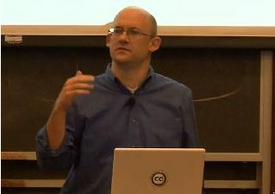 Maybe I should name this west coast lunchtime listen ;-) Be that as it may, Clay Shirky gave a talk last month (click on the image to get to the video) at the Berkman Center for internet and Society covering some of the ideas from his incredible new book Here Comes Everybody: The Power of Organizing Without Organizations. The focus of the talk is Shirky's notions about the enabling power of the Web and along the way he has a lot of interesting things to say about sharing, conversation, collaboration and collective action. There's a lot of power in sharing and Shirky points to several interesting examples of that power.
Here Comes Everybody: The Power of Organizing Without Organizations (Event Video/Audio) Continue reading
Maybe I should name this west coast lunchtime listen ;-) Be that as it may, Clay Shirky gave a talk last month (click on the image to get to the video) at the Berkman Center for internet and Society covering some of the ideas from his incredible new book Here Comes Everybody: The Power of Organizing Without Organizations. The focus of the talk is Shirky's notions about the enabling power of the Web and along the way he has a lot of interesting things to say about sharing, conversation, collaboration and collective action. There's a lot of power in sharing and Shirky points to several interesting examples of that power.
Here Comes Everybody: The Power of Organizing Without Organizations (Event Video/Audio) Continue reading
Agencies not complying with record preservation policies
Agencies not complying with record preservation policies, By Jill R. Aitoro, NextGov, April 24, 2008.
At the hearing, Linda Koontz, director of information management issues at the Government Accountability Office, released preliminary results from an ongoing GAO study of how four agencies managed e-mail and electronic records. ...Koontz said the agencies print and then file e-mails, but about half of senior officials were not following these procedures, and the e-mails for these officials were maintained in e-mail systems that lacked record-keeping capabilities, such as the ability to group the e-mails using a classification system.The House is considering the Electronic Communications Preservation Act, which would strengthen policies for preservation of government records including White House e-mails. Gary Stern, general counsel for NARA said that the legislation's potential cost to agencies could be "astronomical," and noted the bill's requirement that the National Archives would maintain authority over the White House's electronic records might be unconstitutional. Patrice McDermott, director of OpentheGovernment.org, said:
"I understand the constitutional issues, and I don't have a good answer for that.... But one of the concerns is that there is no way to enforce accountability [of] records management in the White House. We understand it's a difficult dance [for NARA]. They're there at the invitation of the White House in many cases, but there needs to be some way for the outside community to hold the White House accountable."Continue reading
Pentagon imbeds defense contractors in media as “message force multipliers”
All governments manipulate the media to garner favorable news coverage and spin the flow of information to put their actions in a positive light. But in a story in Sunday's NY Times (April 20, 2008) entitled "Behind TV Analysts, Pentagon’s Hidden Hand," David Barstow describes a concerted effort by the Bush Administration who used ostensibly objective military analysts to spread propaganda and dupe the American public in a campaign to generate favorable news coverage of the administration’s wartime performance in Iraq. It turns out that those "independent military experts" consisted of “more than 150 military contractors either as lobbyists, senior executives, board members or consultants.” Once again, John Stewart describes this event with wit so that we'll laugh rather than scream. So I'll let him have the last word. And he mentions a GAO report called "Combating Terrorism: The United States Lacks Comprehensive Plan to Destroy the Terrorist Threat and Close the Safe Haven in Pakistan's Federally Administered Tribal Areas" that you can now get your hands on via the Internet Archive.
Five years into the Iraq war, most details of the architecture and execution of the Pentagon’s campaign have never been disclosed. But The Times successfully sued the Defense Department to gain access to 8,000 pages of e-mail messages, transcripts and records describing years of private briefings, trips to Iraq and Guantánamo and an extensive Pentagon talking points operation. These records reveal a symbiotic relationship where the usual dividing lines between government and journalism have been obliterated. Internal Pentagon documents repeatedly refer to the military analysts as “message force multipliers” or “surrogates” who could be counted on to deliver administration “themes and messages” to millions of Americans “in the form of their own opinions.”... ...Over time, the Pentagon recruited more than 75 retired officers, although some participated only briefly or sporadically. The largest contingent was affiliated with Fox News, followed by NBC and CNN, the other networks with 24-hour cable outlets. But analysts from CBS and ABC were included, too. Some recruits, though not on any network payroll, were influential in other ways — either because they were sought out by radio hosts, or because they often published op-ed articles or were quoted in magazines, Web sites and newspapers. At least nine of them have written op-ed articles for The Times.Continue reading
LCSH suggestion Blog-a-Thon
Is there a cataloger in the house?! The fine folks over at radical reference are having a Library of Congress Subject Heading Suggestion Blog-a-Thon. Between now and Sunday, April 27, you can suggest subject headings and/or cross-references which will then be compiled and sent to the Library of Congress. Uber-cataloger Sandy Berman has been doing this for years, so it's great to see others taking on the challenge of collaborative subject description!
Some time between now and Sunday, April 27 at 6pm Eastern:Continue reading
- Select one or more subject headings or cross-references to suggest
- Provide material to support your suggestion (in the form of a link and excerpted text/image)
- Blog it somewhere (your own site; Radical Reference--if you're a registered and authenticated user on the site, you can create your own blog post, if not, just make it a comment to this post; an online file sharing service like Google Docs or Zoho)
- Tag it for del.icio.us: rr_lcsh2008 and for:radical_reference. If you don't have a delicious account email me, and I'll tag it for you.
- If you are suggesting a subject heading not previously submitted to LC (e.g. not on Sandy's scorecard), also submit your proposal to the Program for Cooperative Cataloging.
- For discussion and help, join the Meebo and/or Skype chat,which will be active on Sunday from 4-6 ET for sure, and other times, as staffed.
- If you are in the NYC area, you can come to the ABC No Rio Computer Center on Manhattan's Lower East Side for some in person collaboration.
- We will email a link to the tagged items to LC, print out a copy of each blog post and mail it to Sandy, and we're kinda hoping that the members of the RADCAT (radical cataloging) discussion list will consider entering some of the suggested headings properly into the proposal form