
Home » Articles posted by James A Jacobs (Page 223)
Author Archives: James A Jacobs
When Google and others impose licenses on government documents and other works in the public domain
Access to Old Information, by Steven M. Bellovin, SMBlog, 8 March 2009. Bellovin notes that Google "requests" you use public domain books you download from books.google.com for "personal, non-commercial purposes." This isn't a new issue, of course, and Bellovin points out that Congressional Information Services, Inc. claims that its microfilms of a U.S. government documents cannot be reused "except for individual research." He continues:
What we are seeing is the use of contract law to obtain rights not granted by copyright. If we are not careful, we will see public information locked up. Worse yet, digital records can be protected by so-called Digital Rights Management (DRM) technology, making them inaccessible except on terms dictated by the physical record's owner. ...We need to ask about the fate of public documents (such as government records) and about the role of libraries.... [I]f a private company is going to be the designated publisher, it should not control how the documents are used.He also calls on libraries to do their part to keep this from happening, for "By agreeing to stringent restrictions, above and beyond what would be permitted under the Fair Use doctrine of copyright law, [libraries] undermine their own goals. I would add that, in the digital age, one way we can ensure free access to government information is by making the raw, complete digital information universally freely and accessible. Private sector companies can then add value and put their restrictions on their added value services, not on the content. Continue reading
EFF Launches Search Tool for Uncovered Government Documents
EFF Launches Search Tool for Uncovered Government Documents, Electronic Frontier Foundation (EFF), March 16th, 2009.
In celebration of Sunshine Week, the Electronic Frontier Foundation (EFF) today launched a sophisticated search tool that allows the public to closely examine thousands of pages of documents the organization has pried loose from secretive government agencies. The documents relate to a wide range of cutting-edge technology issues and government policies that affect civil liberties and personal privacy.Search EFF's FOIA Documents. Continue reading
Sunshine Week 2009 Survey Of State Government Information Online
Sunshine Week 2009 Survey Of State Government Information Online
The Sunshine Week 2009 Survey of State Government Information online found that while more and more government records are being posted online, some of the most important information is being left offline. And in some cases governments are charging taxpayers to access records that they already paid for, such as death certificates. Teams of surveyors scanned government Web sites in every U.S. state to look for 20 different kinds of public records. The results were released today at the start of Sunshine Week 2009, which runs March 15-21. The study was developed by Sunshine Week, the American Society of Newspaper Editors' Freedom of Information Committee, the National Freedom of Information Coalition, and the Society of Professional Journalists' FOI Committee.Continue reading
Bad data and bad computer models led to financial crisis
As a data services librarian and an one-time economics bibliographer, I have been following with great interest the way many different people are identifying the source of our current financial crisis as a combination of bad data and bad financial models. Although this is not directly related to government information, I know some of you answer questions about economics, business, and related fields and may find these links helpful.
I think part of my fascination with this is how we keep hearing financial people justifying their "mistakes" by saying that this is a rare event. "Who could have foreseen this?" they say. But these articles say it is precisely the fact that investors ignored the possibility of rare events that caused the problem.
These all have some common ground, but my favorite short-hand is the explanation by Nicholas Taleb. (The Fourth Quadrant: A Map Of The Limits Of Statistics, by Nassim Nicholas Taleb, Edge, Sept. 15, 2008.) He is the author of The Black Swan which is about "highly improbable and unpredictable events that have massive impact." He compares the financial crisis to the situation of a turkey before Thanksgiving.
A Turkey is fed for a 1000 days -- every day confirms to its statistical department that the human race cares about its welfare "with increased statistical significance". On the 1001st day, the turkey has a surprise.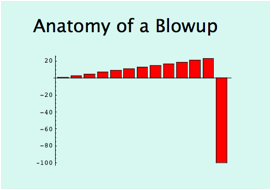
He compares that with the fate of close to 1000 financial institutions that were betting against a "rare event""

Others:
- How Wall Street Lied to Its Computers. by Saul Hansell. New York Times Bits Blog, September 18, 2008. "The people who ran the financial firms chose to program their risk-management systems with overly optimistic assumptions and to feed them oversimplified data."
- Recipe for Disaster: The Formula That Killed Wall Street, by Felix Salmon.Wired, February 23, 2009. "Li's Gaussian copula formula will go down in history as instrumental in causing the unfathomable losses that brought the world financial system to its knees."
- Wired and the Math Formula of Doom, by Ryan Chittum, Columbia Journalism Review, February 26, 2009. "Disclosure’s great. Journalists love it. We need it to inform the public and the public needs it to make good decisions. But it’s naive to think it will enable Mr. Market to work his magic and all will be well. Tough rules with teeth are going to have to accompany fuller disclosure."
- In Letter, Warren Buffett Concedes a Tough Year, By David Segal New York Times, March 1, 2009. "He went on: “These parties looked at loss experience over periods when home prices rose only moderately and speculation in houses was negligible. They then made this experience a yardstick for evaluating future losses."
- The Terminator Comes to Wall Street, By Joseph Fuller, The American Scholar, March 1, 2009. "The first problem is that those who created the models don’t understand the markets.... The second problem is that managers don’t understand the modelers."
Finally, and perhaps related to all the above, Sherry Turkle professor of the social studies of science and technology at the Massachusetts Institute of Technology, is writing a book about computer simulations and finds problems with using them.
In my book, I tell the story of a girl who was a power player of the game Sim City. She talked to me about her “David Letterman Top Ten Rules of Sim City,” and rule number 6 was “raising taxes leads to riots” because when she did that, that happened in the game. She didn’t understand that if I had programmed that computer, raising taxes would’ve led to more social services and greater social harmony. She was drawing a set of conclusions about how the world worked based on the simulation. The trouble with that was not that she was using the simulation, but that the simulation wasn’t transparent to her. - Simulations May Be Causing Real Trouble, interview with Sherry Turkle. Chronicle of Higher Education, Wired Campus Blog, March 13, 2009.Continue reading
Grants.gov slows down with (gasp!) 2500 users!
Grants.gov ("your source to FIND and APPLY for federal government grants") announced on its blog (which is at blogger.com, not a .gov domain, by the way), that it "continues to experience system slowness due to the high volume of users. We have over 2500 users logged-on and over 1200 users conducting searches." Imagine! a government site with 2500 users! Imagine the site sagging under the weight of this! Imagine e-gov! Imagine the government not being prepared to deliver! Imagine the irony! ugh... For more on this, see: Stimulus Applications Could Overwhelm Grants.gov, By Sarah Cohen, Washington Post, March 11, 2009. To be fair, the folks at grants.gov are trying. According to what Netcraft reports, grants.gov is evidently run by a commercial outfit and has multiple servers and probably has load-balancing run, apparently by Big-IP. According to the Washington Post story, "the Department of Health and Human Services, which runs the portal, recently added more storage space for the system [Huh? How about processing power!?] and is working on other modernization efforts." This is not the first time grants.gov has revealed bureaucratic contempt for users; see also: Should Grants.gov Be Abolished? and Grants.gov is Windows-only. The moral, though, is that .gov needs lots of work and lots of money and lots of smart people if we are to be able to rely on having adequate access to online government information. We all want it and are told that online access is the only alternative etc. etc. But until Congress adequately funds IT, we'll have problems like this every time people actually want to use .gov sites in even moderate numbers. Remember when Congressional web servers bogged down when lots of people wanted to read the stimulus bill and email their Representatives? (Surprise! Democracy in action, and Congress was not ready for it.) Sigh... Continue reading
Latest Comments